Pour préparer un voyage au Japon, les brochures touristiques, les cartes et les plans permettent de mieux comprendre le pays, de choisir les régions à visiter et d’organiser les déplacements. Les documents disponibles peuvent également aider les voyageurs à comparer les moyens de transport, les hébergements et les différentes saisons touristiques.
Notre fonds possède un rayon consacré au tourisme, doté de différents guides de voyage, de livres illustrés sur des sites, lieux, villes, etc. À consulter sur place.
Nous possédons un atlas de cartes routières de tout le pays, ainsi que divers atlas et cartes en alphabet latin et en japonais.
Quels documents demander pour préparer un voyage au Japon ?
L'office du tourisme envoie pas mal de cartes et documents par la poste.
En cliquant sur demande de brochures, tu disposes de quelques documents en français ou en anglais, pour ma part j'ai choisi "map of Japan" pour avoir une grande carte du pays.
Alors, vous avez les classiques brochures touristiques, le petit guide de survie, un annuaire des hôtels et autres Ryokans touristiques (c’est quand même mieux d’en trouver hors de cette annuaire et qui n’ont pas l’habitude d’accueillir les touristes… l’ambiance y est plus sympas et traditionnel), les horaires des trains (qui changent régulièrement, donc mieux vaut se renseigner sur place)…. mais le plus important c’est : les plans des principales villes !
Les « tourist map », ne sont pas juste des cartes… mais bel et bien votre planche de salut !
Brochures imprimées et documents numériques
Nous sommes au regret de vous informer que nous avons mis fin à notre service d’accueil public ce 31 mars 2026.
A compter du mois d’avril, nous prévoyons un webinaire une fois par mois (tous les troisièmes mercredis du mois, sauf exception) pour vous communiquer les informations les plus demandées ainsi que répondre à vos questions.
Cepandant, des brochures digitales en français et en anglais sont à votre disposition sur notre site internet.
Il sera par ailleurs possible d’obtenir des brochures papiers lors d’évènements auxquels nous participons.
De toutes façons, sur le site français qui renvoie souvent à des informations en anglais, vous pouvez télécharger des documents.
Délais de réception des brochures
Je viens de commander un ensemble de document, combien de temps pour arriver à destination.
Cela dépend à qui tu as commandé.
Pour l'office du tourisme en 3-4 jours j'ai eu les miens dans une grosse enveloppe kraft.
Le délai dépend donc du service contacté et du mode de mise à disposition choisi. Les documents numériques sont accessibles directement sur le site, tandis que les brochures imprimées peuvent être envoyées par courrier ou remises lors d’évènements.
Merci pour vos renseignements.
Guides, cartes et plans à consulter
Notre fonds possède un rayon consacré au tourisme, doté de différents guides de voyage, de livres illustrés sur des sites, lieux, villes, etc. À consulter sur place.
Nous possédons un atlas de cartes routières de tout le pays, ainsi que divers atlas et cartes en alphabet latin et en japonais.
Les brochures peuvent être complétées par les plans des principales villes, les cartes routières nationales et les horaires de train. Les cartes en alphabet latin facilitent la lecture pour les visiteurs étrangers, tandis que les cartes en japonais peuvent être utiles pour retrouver les noms locaux des lieux et des stations.
Informations générales utiles avant le départ
Formalités d’entrée
No vaccinations are required for foreign travelers coming to Japan.
Currently, Japan has agreements with 67 countries allowing these citizens to enter Japan without the need for a visa.
Nationals of all other countries will require a visa.
Make yourself familiar with the conditions before arriving in Japan.
Douane et effets personnels
Baggage or accompanying items which are deemed as being for personal use only, and are within the restricted quantity of duty-free as specified by the customs regulations.
Find out more about Customs rules and regulations from the JNTO: Customs
Cartes bancaires et espèces
Q : Are credit cards widely accepted?
Although most stores and restaurants will accept Visa, MasterCard and American Express cards, travelers should keep in mind that Japan is still very much a cash culture.
You may find smaller shops or remote ryokan hotels that only accept yen in cash.
Japan has one of the lowest crime rates in the world, so carrying cash is not a real problem.
Travelers Checks are also an option, although it is wise to have these available in either Japanese yen, or US dollars.
Retirer de l’argent au Japon
More than 26,000 Post Office ATMs exist at various locations throughout Japan, and stickers indicate whether a Post Office has an ATM machine.
Cirrus, Plus, Maestro and Visa Electron networks are accepted, as are Visa, MasterCard, American Express and Diners Club credit cards.
Téléphone, carte SIM et Wi-Fi
This can vary depending on your network provider.
Before arriving in Japan, make sure to confirm the compatibility of your mobile phone with your phone line service provider.
It is worth noting that rental phones, sim cards and Wi-Fi are available in Japan on varying plans and costs.
Most major airports have kiosks offering these services.
Do your research to find out what makes the most sense for you.
Budget et hébergement
Japan is an affordable place to travel, even for those on a tight budget.
There is a wide variety of budget accommodation, transport passes, and sightseeing discounts to help support the JNTO: Budget Travel Hints
In reality, Tokyo and other large Japanese cities are not any more expensive than other big cities worldwide.
If you make smart choices, the wide range of shops, restaurants and services mean that your yen can stretch relatively far.
100-yen shops and budget stores abound selling extremely affordable necessities and reasonably priced gifts, and inexpensive restaurants serve meals that cost 1,000 yen or less.
If you book in advance, staying in Japan can be relatively affordable.
There are plenty of inexpensive hotel chains and ryokan hotels-especially in major cities and tourist areas.
Types d’hébergement
Japan offers a wide variety of accommodation to suit all tastes and budgets.
For western-style lodgings, there are luxury hotels and business hotels.
If you prefer Japanese-style accommodations, try a Ryokan (Japanese-style inn) and Minshuku (private guest-houses providing a bed and meals).
For travelers on low budgets, try the Japanese Inn Group and Youth Hostels.
Either ask the travel agent to arrange the accommodation, or contact the hotel directly.
Many hotels now have their own web-site where you can make reservations on-line.
Search from a whole host of JNTO: Hotel & Ryokan Search that cater to every budget.
Quand voyager au Japon ?
The difference between the peak and off-peak travel seasons in Japan is severe.
If you have a flexible schedule, try to avoid these particular time periods when prices skyrocket and transportation and hotels tend to be fully booked.
| Période | Dates indiquées |
|---|---|
| New Year | December 27 to January 4 and adjacent weekends. |
| Golden Week | April 29 to May 5 and adjacent weekends. |
| The Summer Bon Holiday | the week centering on August 15. |
Transports et déplacements
Réseau ferroviaire
Railway networks criss-cross throughout the nation.
Japan Railways (JR)-including the shinkansen lines-connect all major cities nationwide, while private railway companies operate in each region.
Large cities also have plenty of subway and monorail options.
Japan Rail Pass
The Japan Railways Group: Japan Rail Pass is a very economical and convenient method of accessing unlimited travel on JR lines within Japan, including bullet trains-with the exception of the Nozomi.
You can purchase tickets and make reservations from abroad.
There are a variety of unlimited-ride passes for trains, and as mentioned above, most notably the Japan Railways Group: Japan Rail Pass -which covers a huge area of the country.
With this pass, unlimited travel is possible on JR lines including the shinkansen (but excluding the Nozomi train).
and the Tokyu Tourist Corporation, as well as from their affiliated travel agencies in other countries.
Exchange Orders are also available from overseas offices of JAL.
The JR East Japan Railway Company: Seishun 18 also offers JR travel at a discounted price for those willing to take local lines.
Cartes prépayées
The main prepaid cards used around Japan are the Pasmo and Suica-there are other local cards too.
These chargeable cards require a refundable deposit of 500 yen when you purchase one.
They can be charged over and over allowing for smooth travel on trains, buses and some boats.
Réservations ferroviaires
The JR East Japan Railway Company: JR-East Train Reservation -the dense network of trains connecting Tokyo with surrounding prefectures-has a reservation site for the Narita Express (the limited express train that runs between Narita International Airport and metropolitan Tokyo) and the Tohoku/Nagano and other bullet train lines.
Tokyo et Kyoto depuis l’aéroport de Narita
Travelers can reach central Tokyo in a number of ways.
JR Narita Express trains, limousine buses, or trains on the Keisei Dentetsu railway are all on hand to transport you into the metropolis.
The Narita Express is one of the quicker options, whisking you into Tokyo Station in approximately 60 minutes.
The fare is around 3000 yen and the Japan Rail Pass is valid.
Limousine buses also have many direct lines to major stations and hotels, and travel times vary from 60 to 90 minutes depending upon the traffic and your final destination.
Fares for the limousine buses are around 3,000 yen.
The Keisei Dentetsu Limited Express-known as the Sky Liner-shuttles between Narita Airport and Ueno in downtown Tokyo in about 60 minutes.
The fare is around 2000 yen.
There are also other express train options that will take you into the city.
Déplacements entre les aéroports de Tokyo
Limousine buses and Airport Limited Express trains are your best bet for this journey.
Around three buses an hour run between the airports, except early morning and evening.
The trip takes about 80 minutes.
There are a couple of Keisei Dentetsu Railway Airport Rapid Express trains every hour-taking about 110 minutes.
Depuis l’aéroport du Kansai vers Osaka
The JR Limited Express Haruka, the Nankai Dentetsu Railways Rapi:t Limited Express and the limousine bus are your best means of transport into the center of Osaka.
Haruka will take you to JR Shin-Osaka Station in the center of Osaka in about 45 minutes.
The Japan Rail Pass is valid for this journey.
If you use Rapi:t, you can reach Namba Station-the most bustling part of Osaka-in about 30 minutes.
The express train takes about 40 minutes.
The limousine bus operates a number of services to major stations and hotels.
Travel time varies depending on the traffic, but the average time sits at about an hour.
Tokyo, Kyoto et Osaka en shinkansen
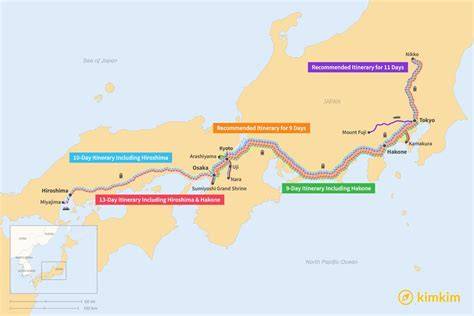
It takes approximately 2 and a half hours to Kyoto and 3 hours to Osaka traveling on the Hikari bullet train.
If you are in a hurry, the Nozomi Shinkansen is 15 minutes faster to Kyoto and 30 minutes faster to Osaka-however your JR Pass is not valid on this train.
Kintetsu Rail Pass
Le KINTETSU RAIL PASS permet des trajets illimités sur les lignes Kintetsu à Osaka, Kyoto, Nara, Mie et Nagoya.
Conduire au Japon
Make yourself familiar with the conditions before arriving in Japan.
- Obtaining a Japanese Driver's License.
- Obtaining an International Driver's Permit.
- Driving licenses from France, Switzerland, Germany, Belgium, Slovenia, Monaco or Taiwan must be accompanied by an official translation.
You need to apply for this before you make your trip to Japan.
Régions et lieux à découvrir
Tokyo, and its neighboring cities of Nikko and Hakone are often the first port of call for travelers to Japan.
The old cities of Kyoto and Nara are also popular.
However, there is much more to explore.
Delve deeper into this site for regional information covering the whole country, including spots of interest, events and activities.
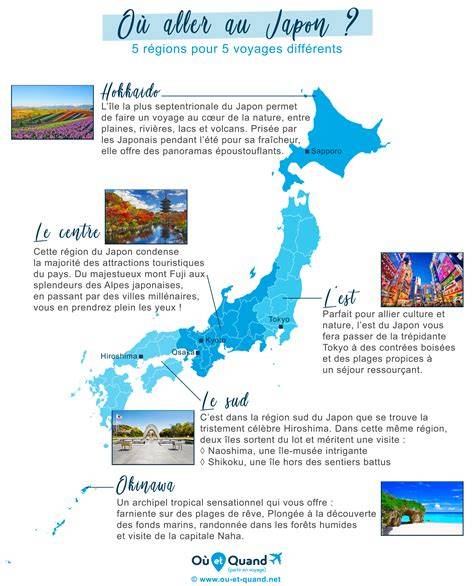
Explorez le cœur du Japon à travers neuf préfectures où histoire, nature, gastronomie et artisanat se rencontrent.
Hirosaki have the most beautiful cherry blossoms and the best apples in Japan.
Tokyo et les espaces naturels
Q : Is all of Japan urbanized like Tokyo?
Metropolitan Tokyo is a big city with a population of over 12 million inhabitants.
Here, company headquarters, commercial establishments and government agencies are concentrated, impacting the Japanese and world economies.
Since there are many office buildings and commercial facilities, you may have the impression that there is no natural beauty left in Tokyo, but the truth is that there are many parks and green spaces, such as Hibiya Park, the Imperial Palace Outer Gardens, and the Meiji Shrine Outer Garden, where greenery in Tokyo flourishes.
Montagnes, parcs et littoral
Since one-seventh of Japan's landscape is mountainous, abundant with rivers, ravines and lakes, you can enjoy beautiful scenery within a short distance of major cities.
The Shirakami-Sanchi Mountains in Aomori and Akita Prefectures and Yakushima in Kagoshima Prefecture have even been designated as World Heritage Sites by UNESCO.
There are also 28 national parks where the natural environment is protected.
Furthermore, since Japan is a nation of islands surrounded by seas on all sides, you can enjoy the picturesque coastline from many parts of the country.
In fact, in subtropical Okinawa, majestic ocean resorts with coral reefs and spectacular beaches stand their ground with first class ocean resorts worldwide.
Mont Fuji et excursions aériennes
Rejoignez le Mont Fuji ou revenez à Tokyo en 35 min.
Vue panoramique splendide et confort aérien haut de gamme.
Survolez Tokyo, le Mont Fuji, Kyoto et Osaka.
Voyage confortable sans embouteillage, avec des vues exceptionnelles.
Iseshima
Les quatre plus grands contenus d'ISESHIMA sont la culture Jingu et la culture Ama, le parc national, la nourriture locale.
Culture et vie quotidienne
Vêtements traditionnels
Q : I hear that many Japanese people still wear kimonos as regular clothing.
Until approximately 130 years ago, most Japanese men and women wore kimonos as their everyday clothes.
However, around that time, Western clothes gradually became popular with Japanese people.
By 1925, Western clothes were commonly worn by many Japanese citizens.
Business suits were the norm for male company employees and female working women started to wear Western-style clothes in the office.
Some people even wore Western clothes at home.
Nowadays, most Japanese people wear kimonos for ceremonies such as weddings or on other special occasions.
Business suits are generally worn as business attire, but other than this, typical Western casual wear-such as T-shirts, polo shirts, sweaters and jeans, are all popular.
Cuisine
It is true that sushi is a typical and popular Japanese dish (particularly in the West), and many Japanese people like it.
But Japanese people don't eat sushi every day.
Sushi is not even a common Japanese everyday food.
In their everyday life, many Japanese people eat food that contains fish and vegetables as essential ingredients, but Japanese also regularly eat Western food such as spaghetti, hamburgers, and steak.
You can find many fast food restaurants, such as hamburger establishments in Japan, and in big cities such as Tokyo, there are restaurants serving a variety of international cuisine.
You can safely say that the Japanese diet is as rich or even richer in variety as that of other nations of the world.
Samouraïs
The samurai were members of a powerful class of warriors who mastered martial arts and were engaged in military affairs.
The samurai class ruled Japan until about 140 years ago, but in today's Japan there are no samurai.
The origin of the samurai dates back to the middle of the Heian period (794-1192), when powerful clans of farmers and military officers, who had guarded noblemen and their residences, were reclassified into the samurai class.
Soon after this time, the samurai class grew powerful.
In 1192, the first Samurai-run government was established in Kamakura, and the samurai class ruled the nation for over 680 years until the Meiji Restoration of 1868.
As the world has seen via the Hollywood production, "The Last Samurai" starring Tom Cruise, samurai warriors are popular subjects for movies, TV dramas and shows.
Geishas
Geisha are women whose profession is to entertain guests in a tatami-matted room at Japanese-style restaurants and other similar establishments.
They perform traditional Japanese arts such as dancing, playing the shamisen (a three-stringed Japanese musical instrument), and playing/singing musical accompaniments.
Geishas can be 18 to 80 years old.
An apprentice geisha is called Maiko in Kyoto and Hangyoku in Tokyo.
It is believed that there are fewer than 10,000 geisha in Japan today.
Some people can form the wrong impression of a geisha's occupation, because geisha are women while their guests are usually men, but it is true that geisha are purely professional artistes who entertain guests by performing traditional arts.
Services d’information et agences spécialisées
De nombreuses agences sont spécialisées dans l’organisation de voyages au Japon.
Cette question et les réponses ci-après sont proposées par la communauté des membres Kanpai dans le cadre du module Kotaete.
Une brochure peut servir de première base de préparation, mais les horaires des trains changent régulièrement, donc mieux vaut se renseigner sur place.
Des services touristiques complets apportent également une aide aux visiteurs étrangers au Japon.
Traveling in a country where you don't speak the language can be both challenging and rewarding.
Even if you don't speak any Japanese, finding your way around Japan shouldn't be too difficult.
English is generally understood throughout the country, particularly in major cities and tourist centers.
Combine this with some positive body language and gestures, and you shouldn't encounter many problems.
Public transportation announcements are frequently made in both Japanese and English, and signs generally include decipherable roman characters or English explanations.
A comprehensive range of tourist services also provide a helping hand to foreign visitors in Japan.
All information is correct as of January, 2018.
tags: #demande #de #brochures #touristiques #japon